

We are constantly bombarded with headlines about AI transforming finance. Yet, when we walk into the operational floors of top-tier tax firms, highly-paid senior partners are still buried in mountains of manual document review.
Right now, top-tier AI models are fully capable of instantly cross-referencing client data against 400-page tax code updates. They can extract clauses from complex international treaties in seconds. Yet, if you look at the daily operations of most tax advisories, this technology is barely utilized.
Why? Because generic AI hallucinates. It leaks data. It acts like a glorified chatbot instead of a serious tool. We call this the "Great Implementation Divide"—and it is silently costing your firm thousands of billable hours every tax season.
The Great Implementation Divide
Recent data illustrates this paradox perfectly. When we map out "Theoretical Capability" versus "Observed Usage," a massive canyon emerges in sectors adjacent to tax.
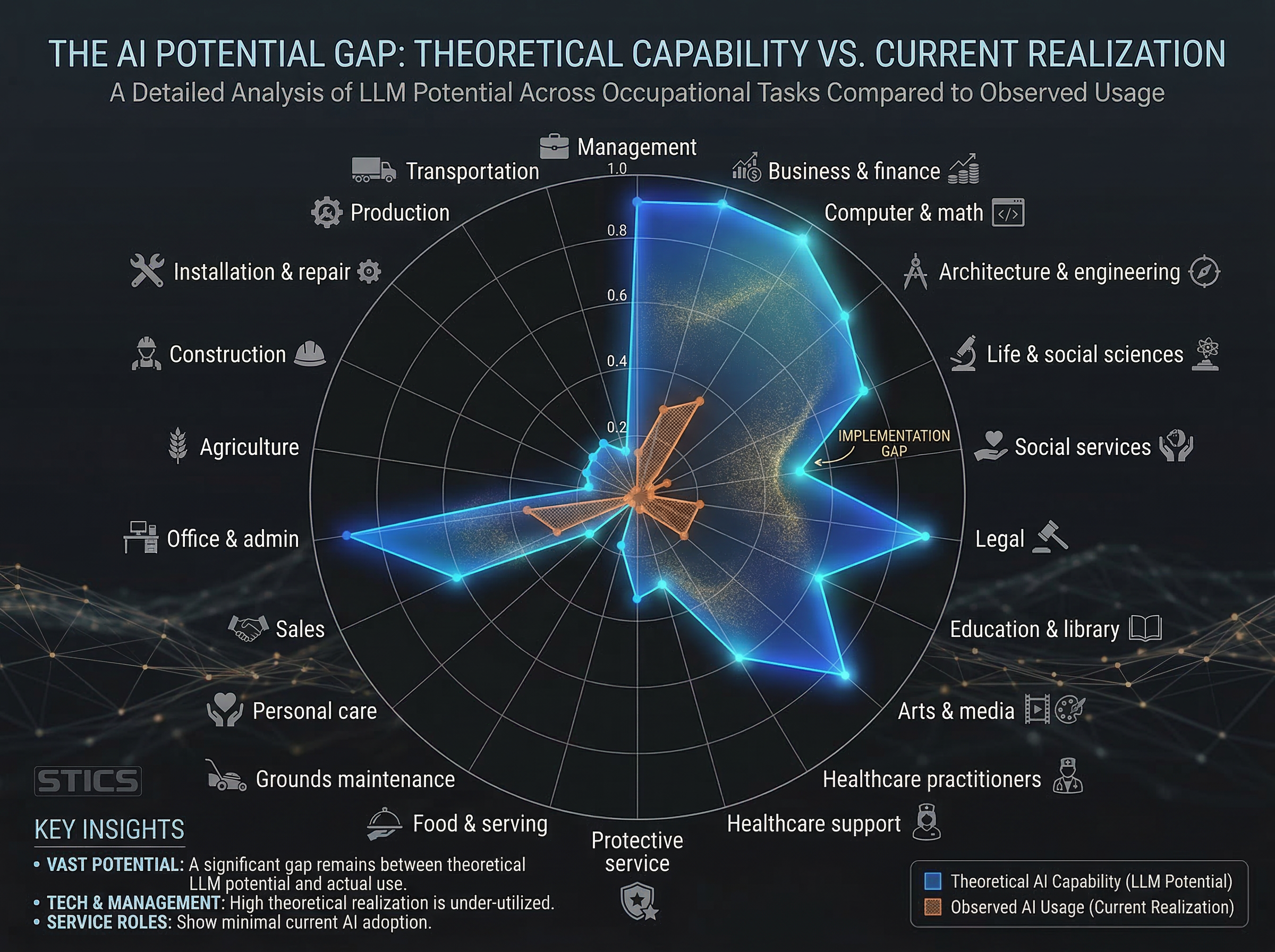
The blue zone (what AI can theoretically perform right now) extends almost to the maximum limit. But the red zone (actual, observed integration into daily workflows) barely registers. Tax and accounting are built entirely on rules and data—the exact environment where AI thrives. So why the hesitation?
The technology to revolutionize your firm's efficiency is already here. You just need the execution strategy to apply it securely.
Why Tax Firms Are Stuck (The 3 Archetypes)
Through our work architecting custom solutions for enterprise clients, we've identified the specific bottlenecks holding firms back. Depending on your role in the firm, one of these is likely keeping you up at night:
1. Managing Partners (The Time Drain)
You are watching billable hours evaporate as your most expensive talent acts as data-entry clerks. The misconception here is treating AI like a "chatbot" instead of an automation engine wired directly into your document workflows.
2. IT & Compliance (The Security Threat)
Tax firms hold highly sensitive financial data. Public AI tools are absolute non-starters. The fear of junior staff quietly pasting client financials into public models creates justifiable "data privacy paranoia."
3. Advisory Teams (The Accuracy Risk)
Tax requires 100% precision. A single hallucination—an AI inventing a non-existent tax code—can ruin a firm's reputation. This "Trust Deficit" paralyzes adoption.
The Blueprint: Crossing the Chasm safely
Closing the gap doesn't happen by buying generic enterprise AI licenses and hoping your partners figure it out. It requires a structured, secure architecture. Leading firms are solving this with two distinct protocols:
- The Ring-Fenced Data Vault: Instead of sending data to the AI, you bring the AI to the data. By building a secure, private instance, your client financials never leave your control, completely neutralizing the security threat.
- The Zero-Hallucination Protocol: By forcing the AI to only query against your verified internal documents and strict regulatory databases (Retrieval-Augmented Generation), you eliminate the AI's ability to "guess." It becomes a hyper-accurate research assistant.
Visualizing the Shift
Hover over the image below to see how expanding capabilities can shift your operational potential from the Red Zone to the Blue Zone.


Stop Operating in the Red Zone.
Let’s discuss how your specific tax firm can safely leverage AI to automate administrative burdens, protect client data, and allow your senior talent to focus on high-value advisory.